2025
A Foundation Model for Non-Destructive Defect Identification from Vibrational Spectra
†Equal contribution, *Corresponding author
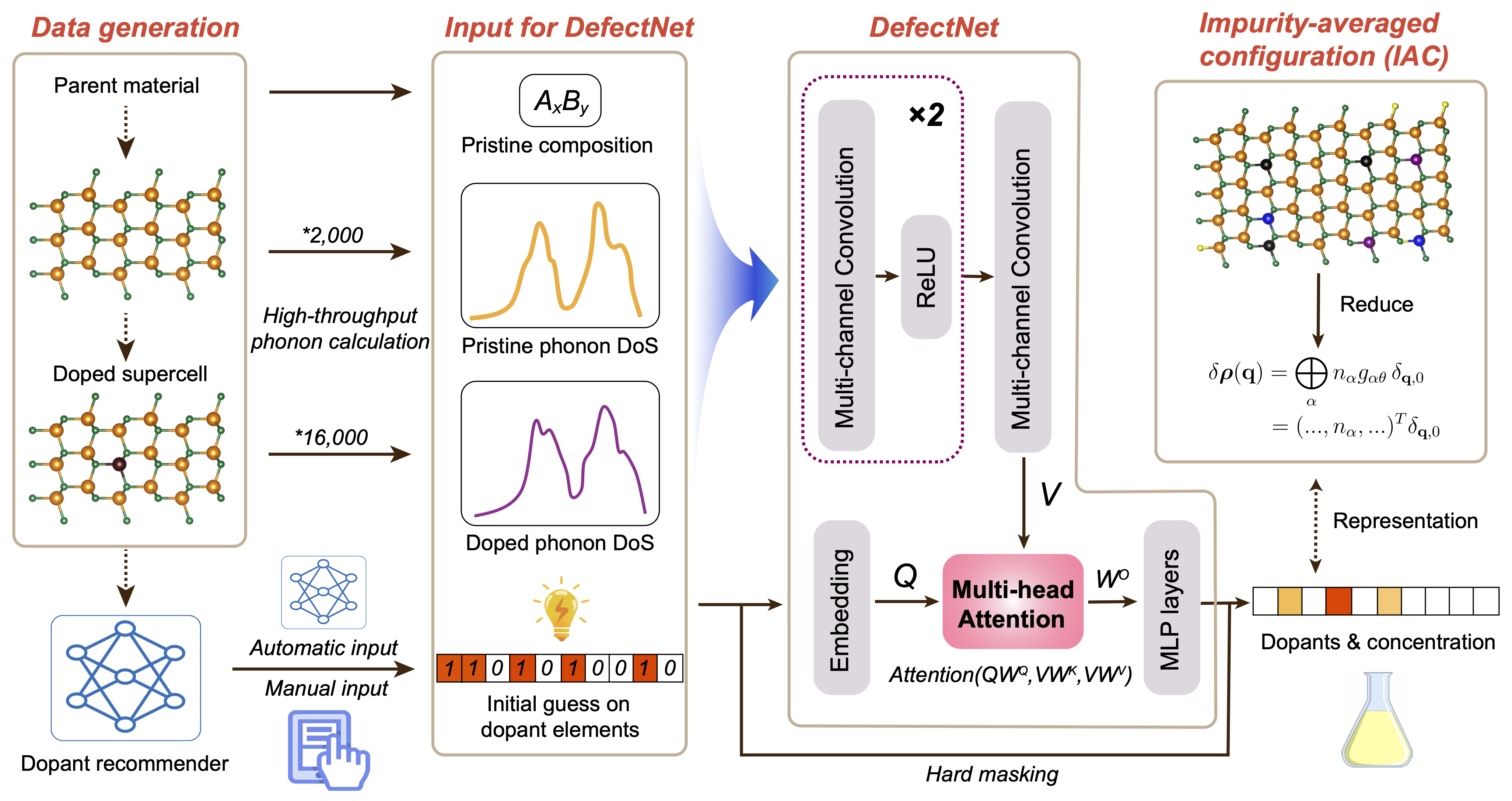
Defects are ubiquitous in solids and strongly influence materials' mechanical and functional properties. However, non-destructive characterization and quantification of defects, especially when multiple types coexist, remain a long-standing challenge. Here we introduce DefectNet, a foundation machine learning model that predicts the chemical identity and concentration of substitutional point defects with multiple coexisting elements directly from vibrational spectra, specifically phonon density-of-states (PDoS). Trained on over 16,000 simulated spectra from 2,000 semiconductors, DefectNet employs a tailored attention mechanism to identify up to six distinct defect elements at concentrations ranging from 0.2% to 25%.
Venue: In review, arXiv preprint
Read Paper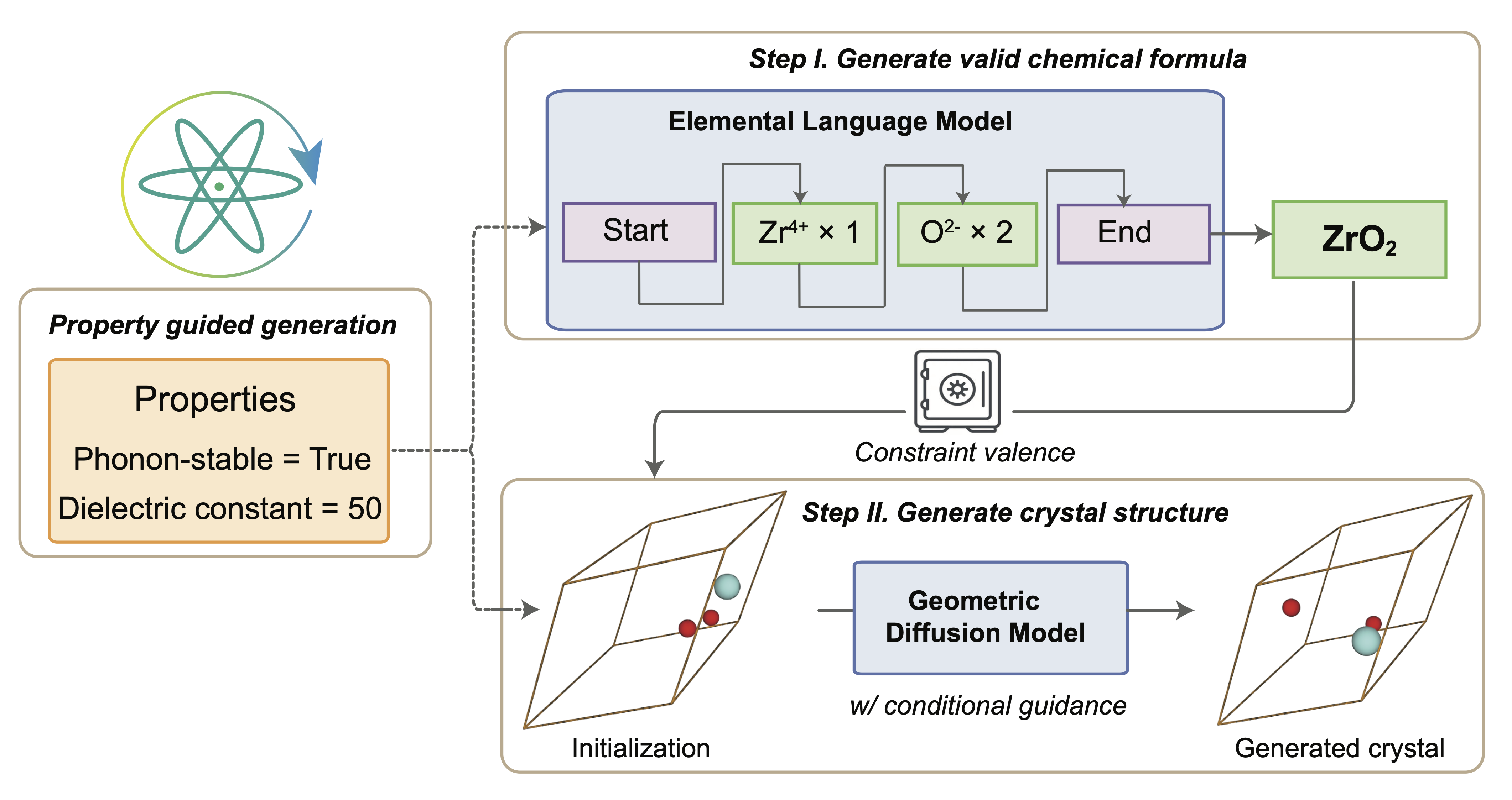
Enhancing Materials Discovery with Valence Constrained Design in Generative Modeling
†Equal contribution, *Corresponding author
This work introduces valence-constrained design (VCD) for generative modeling in materials discovery. By incorporating chemical valence constraints into the generation process, we demonstrate enhanced accuracy in predicting stable crystal structures and accelerate the discovery of novel materials with desired properties.
Venue: In review, arXiv preprint
Read Paper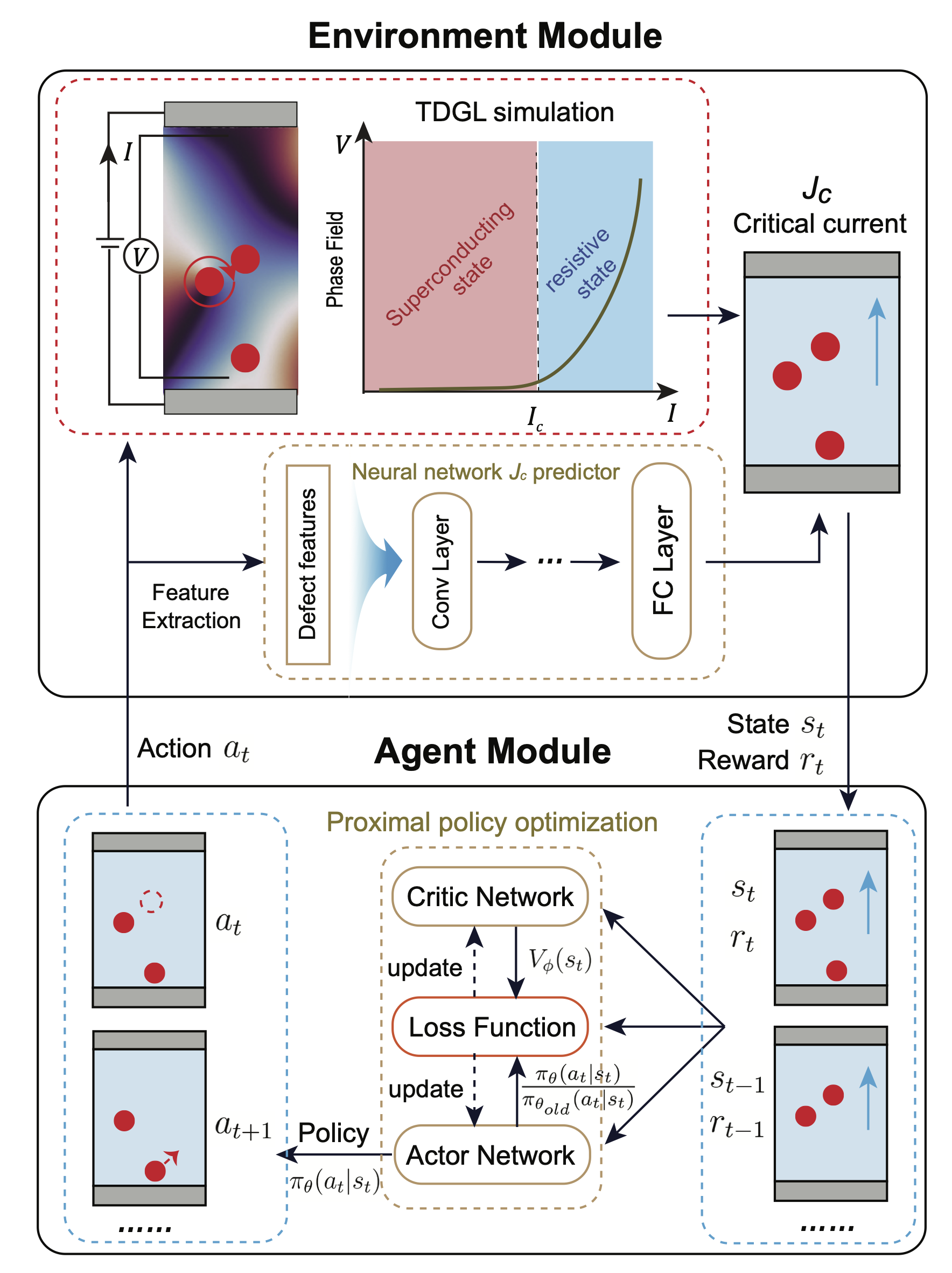
Reinforcement learning-guided optimization of critical current in high-temperature superconductors
†Equal contribution, *Corresponding author
We develop a reinforcement learning framework to optimize the critical current in high-temperature superconductors. Our approach demonstrates the potential of AI-driven methods in tackling complex optimization problems in condensed matter physics and materials engineering.
Venue: In review, arXiv preprint
Read Paper